CSR is the key to achieve sustainable development. Starting from 2020, Citigroup Inc. and the Hong Kong Council of Social Service (HKCSS) have jointly organised the Citi-HKCSS Community Intern Program to nurture socially responsible business leaders for the future. In the past decade, the programme has collaborated with 258 NGOs and social enterprises, and nurtured over 800 UG students with business majors. Every year, the programme will select 80 students with exceptional academic results to participate in 20 hours of workshop training. Students will work in pairs to perform 160 hours of work in their designated organisations.
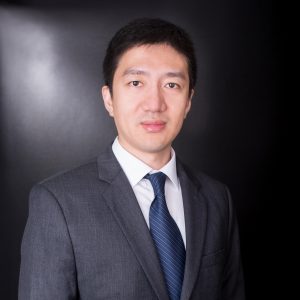
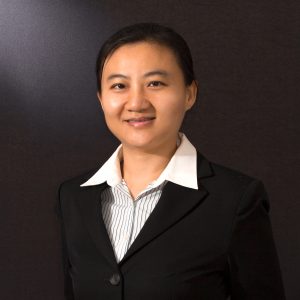
It is a great honour that the team of Ms. Tsoi Ka Wai (BBA(IS), Year 3) is selected as one of the two awarding teams receiving the Grand Award for Excellence, while the team of Ms. Wan Yuen Yan (BBA, Year 2) is selected as one of the four awarding teams receiving the Award for Excellence. On the recognition ceremony, Mr. Edward Yau, Secretary of Commerce and Economic Development, Government of Hong Kong SAR; Ms. Angel Ng, CEO of Citi Hong Kong and Macao; Mr. Chua Hoi Wai, Chief Executive at The Hong Kong Council of Social Service; and Dr. Winnie S.C. Leung, our Assistant Dean (Undergraduate) encouraged the participants to keep up the good work in promoting CSR in the future. Let’s give everyone a round of applause!
Congratulations! Our Chair of Strategy and International Business, Chung Hon-Dak Professor in Strategy and International Business Kevin Zheng Zhou is named by Clarivate in its list of “Highly Cited Researchers 2021” as the most influential in the world. Prof. Zhou’s papers have been highly cited by fellow academics and rank in the top 1% by citations for field and year in Web of Science, hence making a significant impact in ongoing research in their respective fields of study.
This year, it is also the first time that HKU is listed among the top 50 universities with the most highly cited researchers globally. 31 world’s top researchers at HKU are elected, which have more than doubled that of last year’s and remains to be the highest among universities in HK. Let’s give them a round of applause! https://cutt.ly/OTWiyqu
The Inauguration Ceremony of the HKU Business School Mentorship Programme was successfully held on 11 November 2021. We were delighted to welcome a record high of mentors with diversified business background, most of whom are alumni, friends and supporters of the Faculty, as well as 80 student mentees to embark on this year’s mentorship journey.
Professor Hongbin Cai, Dean of HKU Business School kick-started the event with a warm welcome to our mentors and mentees. He expressed gratitude to mentors for their generous support to the Faculty over the years, and hoped mentees this year could get the most out of the programme.
Three young alumni Mr. Tony Au (BFin(AMPB) 2021), Private Banking Analyst, HSBC, Ms. Gigi Kong (BBA(Law)&LLB 2020), Strategy & Operation Analyst, Deloitte Consulting, and Mr. Udara Senevirathne (BEcon&Fin 2017), Senior Officer – Business Development, New World Development Company Limited, who had previously participated in the Mentorship Programme as mentees had shared their experience in the mentorship programme, and their tips on how to maximise the programme outcome.
This year marks the 20th Anniversary of the Faculty of Business and Economics (HKU Business School). The Faculty strives to be a leading, globally impactful academic institution of business and economics and provide opportunities for students to connect with the real business world. Mentoring is especially valuable in empowering students by sharing of mentors’ knowledge and experience, encouragement and inspiration. Through regular mentoring sessions in the academic year, we believe students can gain professional and personal developments.
Emerged in the era where the Hong Kong economy took flight, “Lion Rock spirit” has become the dogma among generations of Hong Kongers, that quality of life and social mobility could be achieved through grit and perseverance. But as the momentum of Hong Kong’s economic growth is slowly losing its velocity, opportunities to climb the social ladder dwindle. Low interest rates, excessive liquidity in the market, and the coronavirus pandemic have devastated the livelihood of the grassroots and widen the wealth gap to an unimaginable level. Many still live with the Lion Rock Spirit, but is there a Lion Rock Dream?
The fifth and last session of the HKU Business School x HKGCC Economic Reboot Webinar Series was successfully held on November 11, 2021 with the theme “Social Inequality: Does the Lion Rock Spirit Still Work in Hong Kong?”.
Professor Richard Wong, Philip Wong Kennedy Wong Professor in Political Economy, Provost and Deputy Vice-Chancellor of The University of Hong Kong and Ms. Shalini Mahtani, Founder & CEO of The Zubin Foundation and Community Business shined a spotlight on the deep-seated issue of social inequality in the city and brought forward illuminating antidotes in remedying the problem. The session was moderated by Mr. Tony Miller, Chairman of the HKGCC Economic Policy Committee.
The webinar began with Professor Richard Wong’s expert commentary on how housing inequality hinders not only personal mobility but also intergenerational mobility in Hong Kong. The growth of income has dropped so far behind from property price, that individuals who have worked a lifetime may still fail to afford the down payment of an average flat. This is a worrying situation as it will dampen the Lion Rock Spirit, and kill the upward incentives of an entire generation. Professor Wong believed that the crux of the problem lies within our city’s broken homeownership ladder. Re-launching the Tenants Purchase Scheme to allow public house tenants to purchase public housing units at an affordable price, may be the solution to alleviate social inequality.
To delve further into the issue of social inequality, Ms. Shalini Mahtani unravelled the unseen plights of the ethnic minorities in the city, who are marginalised by the education system and social structure that are Chinese-dominated. She said that despite Hong Kong hailing itself as an open and multicultural city, the 260,000 population faces structural racism on a daily basis such as not gaining equal access to government schools and job opportunities. The non-inclusive education policy was described by Ms. Mahtani as an unjust system that bars the ethnic minorities from learning Chinese, getting a better job and blending in with the mainstream society. Given the structural segregation, she contended that the efforts made by the neglected group to climb up the social ladder often are made in vain and they eventually end up at the bottom of the pyramid, which implies that the successful formula of the Lion Rock Spirit does not apply to them.
The seminar concluded with interesting exchanges in the Q&A session, where the two speakers utilised this opportunity to further elaborate their points.
Professor Wong added that in critical issues such as housing and education, the government must unite different stakeholders and remove the obstacles ahead. He reminisced that one of his teachers, the renowned Professor Milton Friedman, once said that the only social responsibility of private corporations is to make profit. But contextualised in the 21st Century, he believed that Professor Friedman will agree with Professor Peter Drucker, that the efficiency of the private sector is needed to improve our society as a whole. The government is not omnipotent and as we all live in the same community, it is the social responsibility for all to be thoughtful on social inequality.
When asked whether integrating into the Greater Bay Area will alleviate social inequality, Professor Wong believed that it is the right direction to go. However, he urged the authorities to be cautious of negative externalities when fathoming cross-border mobility policies.
To eliminate the structural racism, Ms. Mahtani advocated for a reform in the current education and language policy. She proposed the formulation of Chinese as a second language curriculum to cater to the needs of the ethnical groups and remove the language barriers arising from different cultural backgrounds and origins. Also, she remarked that the Lion Rock Spirit does not only represent the “Can-do” disposition, but also underlies the spirit of benevolence and solidarity as being part of the community. She suggested the business sector to play an active role in cultivating an inclusive environment for those who regard Hong Kong as their loveable homes.
Mr. Tony Miller concluded that he was very honoured to moderate this workshop series from July to November, and was deeply touched by the active support provided from both HKU Business School and other participating parties. After briefly summarising the key points of the previous sessions, he thanked everyone who had participated and attended. Thinking is the first step before action, and he hoped that we have had our fair share of food for thought to prepare ourselves in making a better future for Hong Kong.
Born in a scholar family, Dr. Zhang aspires to use her knowledge to generate positive impact to the world. Impressed by the intellectual prowess of the HKU alumni she had met in her PhD years, Dr. Zhang decided to embark on a pilgrimage to HKU Business School on July 2020 as an Assistant Professor in Economics.
Macroeconomics as the touchstone for policies
“I majored in mathematics, statistics and economics during undergraduate studies. I really enjoy learning new things and sharing my findings to others. Probably because both of my parents are professors,” Dr. Zhang said with a laugh. Although her interests are in mathematics, the desire to improve the society has encouraged Dr. Zhang to become a scholar in macroeconomics.
As quantitative macroeconomics research combines data with structural models, the findings of scholars can provide guidance to policy makers. “by building up a quantitative structural model and estimate it carefully to mimic what happens to the real economy, economists can rely on the model to evaluate the potential impact of a certain policy on different aspects of an economy such as output, consumption, welfare, and inequality. This is what we a quantitative macro approach. During my tenure as a part-time researcher at the Federal Reserve Bank of Minneapolis, a lot of my colleagues had used the quantitative macro approach to provide high-impact analysis and advice to policy makers on monetary policy and other strategic initiatives,” said Dr. Zhang.
To make sense out of the decline in labour share of the global economy
In recent years, there is a secular decline in labour share and a rise in industrial concentration in the global economy. This means that labour compensation as a share of national income is declining, while the market shares of mega firms are growing. A recent research conducted by Dr. Zhang explains that this phenomenon is closely related to rise of intangible capital, such as software and R&D. “While many argues that this trend may lead to greater market power, my paper posits that the rise in industrial concentration is possible to be the natural consequence of technological advancement that favors those large, productive, and intangible-capital-intensive firms. It may not necessarily cause market inefficiencies,” explained Dr. Zhang. She hopes that her paper can give a sense of relief to policy makers and prevent over-intervention.
How should entrepreneurs be taxed optimally?
In addition, the decline in entrepreneurship is another potential problem in many countries in the world such the U.S. “Entrepreneurs belong to a special group of households. In the US, even though they make up only 7 to 8 percent of the population, they own nearly one-third of the total wealth. What’s more, they are also major job providers and market innovators,” said Dr. Zhang. The loss of entrepreneurs could destroy the competitiveness of a country in the long run. In order to provide insights for policy makers, Dr. Zhang decides to conduct a research on the tax side. “Taxing entrepreneurs is tricky”, said Dr. Zhang, “On the one hand, they are important to a country in many aspects, and the government would not want to scare them away with high tax rates. However, on the other hand, since entrepreneurs are usually relatively richer and wealthier than other people, you do want to tax them more to close the fiscal deficits and reduce income inequality.”
By using data from the Panel Study of Income Dynamics, Dr. Zhang focuses on self-employed business owners that are actively managing their businesses. She aims to compute optimal labour and business income taxes in a quantitative macro framework, in order to determine the optimal tax rate for entrepreneurs. As our school will soon open an entrepreneurial and innovation centre in Israel, Dr. Zhang research will be of great use for the centre’s future operation.
To deliver quality education with research-based evidence
Dr. Zhang has already been teaching in HKU for a year. “I look forward to Spring 2022 semester as I will be teaching an advance course closely related to my research called Inequality and Growth,” Dr. Zhang said. She hopes that her research on the labour market could inspire students to strategise new ways to reduce the staggering income inequality in Hong Kong.
The Faculty Teaching Award Scheme recognises and rewards teachers with outstanding achievements and significant contributions in teaching and student learning in the Faculty. The award-winners for the academic year 2020-21 are:
Faculty Outstanding Teacher Award (Undergraduate Teaching) Dr. Matthias BUEHLMAIER Principal Lecturer
“I feel very honored to receive the Faculty Outstanding Teacher Award (Undergraduate Teaching) in 2020-21. It is fair to say that without the tremendous support from colleagues at HKUBS and HKU over the last few years, it would not have been possible to achieve this award. I am very grateful and thankful for colleagues’ constant encouragement and advice that allowed me to grow and develop as an educator. Last but not least, I would like to thank the incredible students at HKU. Their desire to master new skills and knowledge has always been an inspiration for me to be the best “version of myself” as a teacher. I look forward to contributing to HKU Business School in the future in order to advance teaching and learning together with our wonderful colleagues and students.”
Dr. Yiwen ZHANG Associate Professor
“I believe there are two essential elements that are key to effective learning of organizational management – evidence-based content and experiential delivery approach. First, I choose to focus my teaching on management concepts and theories that are well substantiated by scientific evidence. I take every chance to explain to my students how the science of human behavior enables us to understand our own biases and make more effective decisions. I also enjoy communicating with students the latest development in management and leadership research and nurturing their curiosity and passion in examining the reliability and validity of their own ideas with scientific rigor. Second, it is crucial to create a safe, fair, and empowering environment in the classroom to promote students’ full engagement. I actively interact with my students in all courses by frequently soliciting their own views and comments, challenging existing assumptions, facilitating discussions and debates, and encouraging continued individual and group learning outside the classroom and beyond the end of the course. Our undergraduate students are active learners and original thinkers who have, yet, limited exposure to organizational life. It is my job to design and flexibly adopt a variety of experiential and immersion teaching tools such as cases and simulations which provide students the opportunities to make high-stake managerial decisions without suffering from any real consequences, to feel the intensity and mix of emotions in conflict scenarios, and to witness the effectiveness of different solutions or coping strategies introduced in the lecture. I also encourage students’ introspection during these experiential class activities which forms an understanding of their own personalities, cultural biases, and leadership styles. I am often proud of my students for overcoming their anxiety and fear in collaborative work and opening themselves up to a full learning experience in management courses.”
Dr. Jinzhao DU Assistant Professor
“Effective teaching is a two-way learning process. Students’ involvement is determinant of my teaching’s success. I always tell my students that they should treat the course as a venue for us to learn from each other. In addition to absorbing knowledge from me and their fellow classmates, students are strongly encouraged to influence others with their valuable input. The two-way learning mindset greatly inspires students to reflect on their own experiences, actively share their perspectives, relate them to the knowledge taught, and develop critical thinking. It even leads to knowledge co-creation from both my students and myself.”
Faculty Outstanding Teacher Award (Postgraduate Teaching) Mr. David LEE Principal Lecturer
“I have always felt that teaching is an absolute privilege. With the disruption to classroom teaching that we have experienced due to the pandemic, this feeling has only grown. Without a doubt, I have been blessed to teach wonderful, curious, and motivated students. I am so grateful for the opportunity to engage with such students in the endeavor of learning.
I am convinced that during times of disruption a teacher can have a profound, positive impact on students. By shaping a meaningful learning journey, we can all grow together during such times, creating transformational learning opportunities for both student and teacher that have lasting influence.”
Dr. Alex CHAN Associate Professor of Teaching
“I believe that every student in my class is a distinctive individual learner. I do my best to recognize individual students and understand their individual learning progress and needs. Through developing a mutual respect relationship between teacher and students, a teacher can provide personalized support and encouragement to individual students in their learning journey to enhance their learning interests and commitment. This mutual respect and understanding relationship is essential for me to develop an effective teaching and learning environment to handle the unexpected changes and challenges faced by students and teachers during these few years.”
Dr. Chao DING Principal Lecturer
“Students’ learning experience should extend beyond the scope of textbook concepts and terminologies. An effective way to enhance teaching and learning is to provide students with ample real world examples and practices so that they learn by doing. Planting a clear course roadmap in the students’ mind also improves the effectiveness of learning. For every milestone, small and large, students are kept in the loop about “where they are right now,” and “where they are moving forward.” With such efforts, students are able to piece together knowledge in a more systematic way.”
Dr. Xiaowei ZHANG Assistant Professor
“One of my research areas is reinforcement learning, a machine learning paradigm that studies how an intelligent agent should interact with an uncertain environment in order to learn, improve, and adapt its decision-making strategies. It is the cornerstone of many artificial intelligence systems such as AlphaGo and autonomous vehicles. There are three key factors for building a successful reinforcement learning system:
‧Rewarding signals (to align the short-term and long-term learning objectives)
‧ Timely feedback (to provide enough opportunities for the agent to adjust its strategies)
‧ Sufficient exploration (to ensure the learned strategies are robust relative to potential changes to the environment in the future)
Interestingly, these three factors are important not only for teaching a “machine” to learn to complete a task, but for teaching a student to learn a subject. This is also my philosophy when I teach machine learning and data analytics to business students:
‧Design exercises using real data from business environments
‧Facilitate online/in-person interactions during the class
‧Develop a diverse set of examples from various business areas
I appreciate the privilege of teaching at HKU. It allows me to learn, improve, and adapt as well.”
Faculty Teaching Innovation Award Dr. Rujing MENG Associate Professor of Teaching
“My teaching innovation closely reflects and reinforces my teaching philosophy. As a firm believer of a student-centred approach and learning-by-doing principle, I implement hands-on projects and let students play a central role in constructing their own knowledge. For example, I designed a group trading project in the course on investments to IMBA and MFin students. Through the project, students not only examined the financial models in a live setting, but also actively learned from peers. Also, they experienced the excitement and heart-beating market movements, and consequently learned the importance of personality and emotions in making the investment decisions.”
Dr. Guojun He is an economist specialised in environmental economics and development economics. Grasping the opportunity to spearhead the line of research related to environmental and economic policies in HKU, Dr. He had officially joined us in July 2021 as an Associate Professor in Economics.
Fascinated by economics practicality
“When I started studying economics in college, I was deeply impressed by how efficient and practical that this discipline is in bridging academic knowledge to the real world. I can see how economics adds positive values to the betterment of the society,” said Dr. He. In retrospect, Dr. He is grateful to have the serendipity to learn from renowned scholars. He added, “I was lucky enough to be taught by elite Chinese economists such as Professor Justin Yifu Lin and Professor Yingyi Qian in my undergraduate years, and received guidance from other established professors during my postgraduate and postdoctoral years in University of California, Berkeley and Harvard University respectively. Their guidance has nurtured my interests in academic research and has caused me passionate to learn more about the unknown.”
As China is developing rapidly over the years, the process of industrialisation also brings environmental pollution. Against this backdrop, Dr. He hopes to leverage his economic knowledge to improve this status quo. On the one hand, he aims to provide guidance to policy makers by studying the effectiveness of environmental policies, and analyse the costs and benefits from industrial activities; on the other hand, he aims to strategise different incentive mechanisms to improve the performances of frontline civil servants in order to provide better public services.
Can the public help in policy execution?
Since 2013, the Chinese government had required firms to reveal real time data of their discharge and emissions activities, as means to facilitate authorities to combat illegal discharge. In this context, Dr. He had decided to carry out a randomised control trial to investigate whether civilians participate in the monitoring process will be conducive to the authorities. By hiring a large number of volunteers to monitor industrial sites with serious pollution records, Dr. He observed that civilians’ assistance can indeed improve the authorities’ efficiency. “The authorities will quickly respond to citizens’ complaints. Moreover, if firms realised that they are being eyed-on, the chance that they would violate the emission standards again will reduce by 50% on average,” said Dr. He.
Better working performance than flatter two bosses in tandem
In the sphere of economic development, Dr. He is devoted to investigating how the government can improve governance and provide better public services. “It is one of the most challenging issues the government faces, both now and in the future, that’s why I want to study it.” Dr. He added.In one of his studies, Dr. He designed an assessment mechanism for civil servants at basic rank in the mainland to relieve the problem of “flattering the supervisor.” Dr. He explained that as duties of basic rank civil servants are very diverse, it is difficult to assess them objectively. As such, some civil servants tend to focus more on flattering their assessment officer rather than focusing on their work. “However, I believe that this will be a way much harder to achieve if you don’t even know who is going to assess you. So our research team proposed that the local government should randomly choose the assessment officers among a civil servant’s two supervisors, and the candidate will only know who will be the real deal on the assessment date,” said Dr. He. Flattering two officers in tandem will make the person look “disloyal”, but appeasing only one officer will likely lead to resentment from the other one. Dr. He posited that, “Under such circumstances, the person will focus more on work than kowtowing, which will be appreciated by both supervisors.”
The first environmental economist in HKU
Other than focusing on his research work, Dr. He is also a dedicated educator. “When I was teaching in another local university, I observed that non-business majors students were also interested in taking business courses, especially those focusing on social problems. Although some of them felt inevitably unconfident due to the lack of economics knowledge, I had made sure that there was always a mixture of business and non-business majors in each project group so that they could learn from each other,” said Dr. He. By enabling students to understand business issues with a multi-disciplinary lens, many non-business students have developed strong interests in economics research and knowledge creation. To Dr. He, this is his most gratifying teaching experience in Hong Kong.
Joining HKU Business school, Dr. He will be teaching two new courses about environmental economics for both the undergraduates and postgraduates. Dr. He told us that, “Environmental economics has become a hot topic recently, so I am very honoured to be entrusted by the Faculty’s management to be a pioneer in this field. Through education, I hope I can also open a new research area for aspiring young scholars to join the academia.”
The global talent race is getting increasingly fierce with the development of disruptive technologies such as AI and big data. To remain relevant in the international landscape, we must plug our brain drain and boost our talent supply.
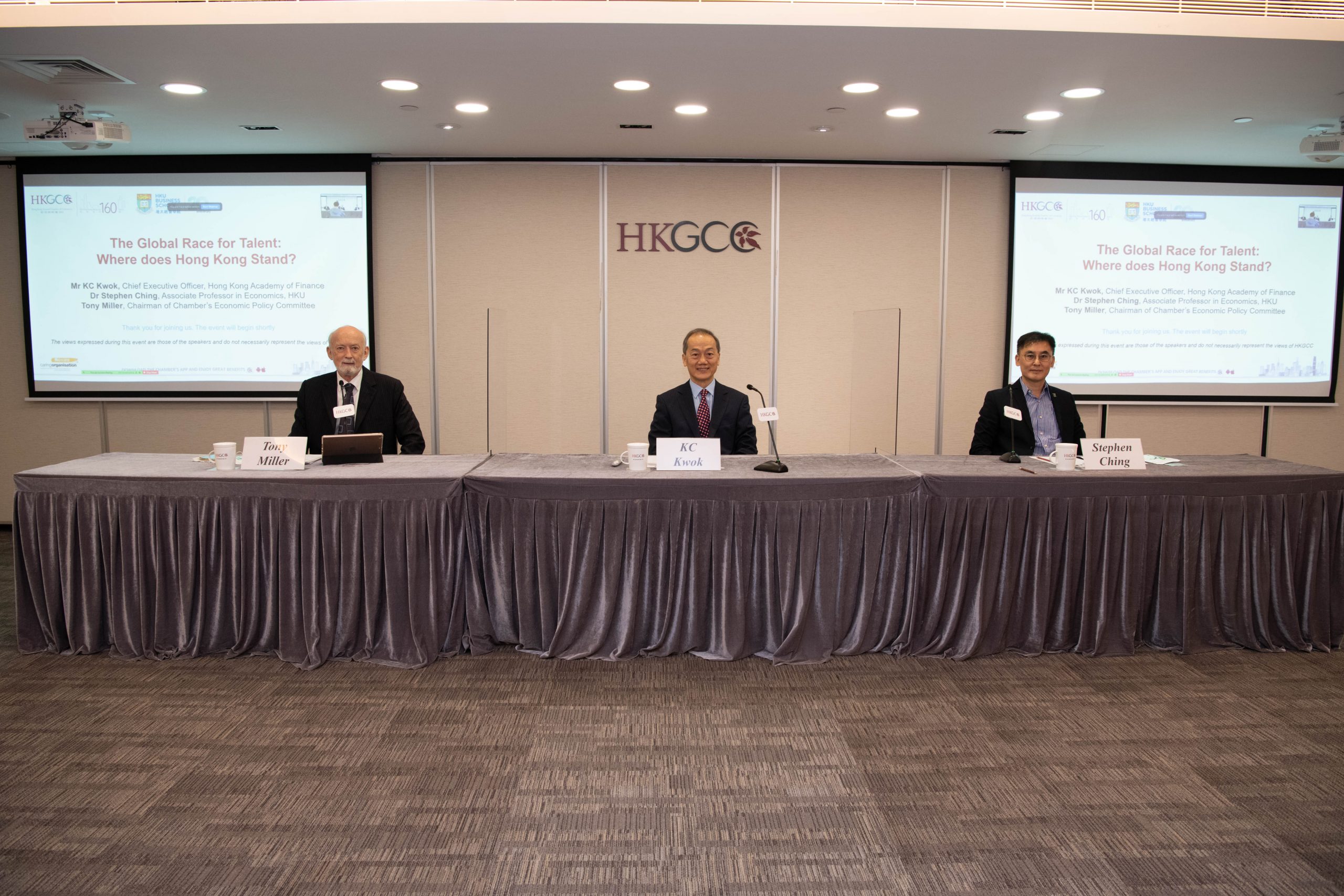
Themed “The Global race for talent where does Hong Kong stand?”, the fourth HKU Business School x HKGCC webinar was successfully held on October 20, 2021 to gauge views from business experts and scholars to fathom new talent strategies amidst an ageing population.
The thought-provoking session was led by Dr. Stephen Ching, Associate Professor in Economics at HKU Business School and Mr. KC Kwok, CEO of the Hong Kong Academy of Finance (AoF), and moderated by Mr. Tony Miller, Chairman of the HKGCC Economic Policy Committee.
The webinar started off with the presentation of Mr. KC Kwok on the current position of Hong Kong in the global talent race. Mr. Kwok posited that Hong Kong is only attractive to corporations and senior managers overseas with its low tax rates and lucrative remuneration packages, but high living costs are deterring mid-level talent from putting down their roots here. He also criticised that there is a mismatch between our talent pool and the market’s demand. While Hong Kong has a huge demand on fintech and green finance, our city is not only unable to supply these talent, but also has way less aggressive talent attraction policies than our neighbours. Therefore, more investments on education and a reform on our talent policy are necessary. At the end of the day, Mr. Kwok believed that the economic clout of a city is limited, and to integrate into a bigger regional block is the key to our future success. He looked forward to seeing more integration between Hong Kong and other GBA cities.
In contrast to Mr. Kwok’s comprehensive review, Dr. Stephen Ching explored the topic of nourishing and retaining talent from another perspective by focusing on the post-secondary education system of Hong Kong. He firstly gave a detailed overview of the structure of the system by highlighting the number of enrolments in different UGC-funded and self-funded programmes. In face of claims that our tertiary education has failed to be responsive to market demand, Dr. Ching maintained that our undergraduate education aims to provide a whole-person training to equip the next generation to be visionary and be adaptive to ever-changing needs, whereas the taught postgraduate education serves the purpose of equipping them with advanced and practical skills to fill the demanding job vacancies. Therefore, he remained optimistic that Hong Kong is not going to lag behind in nourishing talent and embracing economic transformation. However, he recognised the need for the government to double down funding in research and academic programmes as global talent competition intensifies.
The seminar came to an end with a stimulating Q&A session. Using the story of Google’s online auction system, Dr. Ching further elaborated that the value of academic research is pivotal to achieve sustainable economic development. He posited that receiving education is not entirely for job hunting, but also to imagine the future. Mr. Kwok added that more communications with our mainland partners are needed to better synergise and co-cultivate a GBA talent pool. On our side, we must think deeply on how to close the gap between sub-degree programmes and the practical needs of the job market. Mr. Tony Miller concluded that the webinar today had covered a lot of the talent issues in the high-end sectors. He urged us to think more about the shortage of blue-collar workers in Hong Kong and what we can do about it. All speakers agreed and they look forward to engaging in more in-depth discussions and debates among experts and business leaders in the society.
The delight of making new discoveries has kept economics Professor Wing Suen committed to research for decades.
The Henry G. Leong Professor in Economics at the University of Hong Kong’s School of Economics and Finance counts doing research and ‘learning something new every day’ as among the privileges of his job. “It is not just about letting students learn something new; I am also learning new things constantly from reading articles, going to seminars, talking to colleagues, who always have new things to teach me. That made my day.”
Professor Suen is filled with even more gratitude after being elected as one of the 51 fellows of the Econometric Society, an international society for the advancement of economic theory in its relation to statistics and mathematics. He said: “It is great to be in the company of scholars whom you admire. There are a lot of great economists in the Society. I am thankful to all my co-authors who had collaborated with me in my work, without whom it would be impossible for me to gain the honour.”
An expert in microeconomics – a core field of economics that studies human behaviors – he had served as a member of the Minimum Wage Commission and the Competition Commission. But rather than social advocacy, he is more committed to theoretical work, intent on advancing knowledge about diverse human behaviors and their implications for society.
His time is often taken up by poring over literature from his field, thinking through research topics, building mathematical models and writing mathematical equations in order to deduce implications for a topic. “I am more interested in understanding than in changing things,” said Professor Suen.
Most of his research is related to information, an area in which economists have done more pioneering work than other social sciences, according to Professor Suen. The projects he worked on also involve issues affecting the society. One currently underway focuses on the much-reported phenomenon of tutoring, a prominent trend in Asia that has spread to parts of the West. In his view, higher grades received with the help from tutoring does not necessarily reflect students’ true capabilities or capacity to learn.
Putting incentives at the centre of the study, he has explored information related to students’ academic performance, and looked at how the information is used, distorted or manipulated. He calls it ‘signal jamming’ – the fact that many students are receiving tutoring support makes the information about students’ abilities less informative. “Once we understand the incentives, the problems facing the universities and students, we may be able to design better admissions schemes, select better student and save resources,” said Professor Suen.
A preliminary finding of the research shows that despite an increased supply of degree places, the tutoring trend has far from declined. A possible factor could be the brand name effect of universities, Professor Suen said. “That is another subject for research. Nonetheless, you cannot arrive at some conclusive ideas without sitting down to write models and think through all the implications of the problems.”
On minimum wage, he is pleased to see that none of the negative effects raised by opponents to the minimum wage law introduced a decade ago have materialised. “The positive effects are visible. It has improved the livelihood of the grassroots population.”
He also witnessed the remarkable growth of HKU, his alma mater, alongside the growing influence of its Business School, which he joined as teaching staff in 1989 upon finishing his doctoral studies at the University of Chicago. “When I first joined, there wasn’t much of a research environment,” he recalled. “For the School, it has also grown in size and in the research culture; I can talk a lot about other fields such as strategy, finance, marketing, with other colleagues in the Business School. It is a very fertile and productive environment.”
The School is well-positioned to further expand its influence in Asia and beyond. “We are in a leading position in economics in Asia. That is partly because Hong Kong, as an international city, attracts talent and has a culture of openness and international outlook. HKU is among the most successful universities in Asia with a culture that focuses on international publications, peer review, and communication with the international community of scholars.”
To sustain the success, he notes the importance for Hong Kong to remain an open society with a free flow of information. “It is vital to maintain freedom of expression, freedom of the press and academic freedom.”
He supports a free approach as well with regards to university education, encouraging students to follow their passion in choosing courses. “You have to have some core skills that can guide your thinking but when it comes to electives, it can be a course on Mozart if that is what you like.”