



From Quantum Physics to Quantitative Marketing – Dr. Chu (Ivy) Dang

Born with a desire to explore the unknown, Dr. Ivy Dang aspires to create positive impact to the world via knowledge creation. Starting off as a science major in Applied Physics and spending two years studying Quantum Physics at PhD level, Dr. Dang had eventually realised that her true interest lies in quantitative marketing. Dedicated to apply the quantitative reasoning and problem-solving skills from natural science to business studies, Dr. Dang has officially joined us on February 2020 as an Assistant Professor in Marketing.

The desire to advance the science and practice of marketing

Fascinated by the mathematical beauty of the universe, Dr. Dang had once aspired to understand how things work from physics and mathematical principles. But when she alighted in Hong Kong for her doctoral studies, her research interests had begun to changed. From her point of view, Hong Kong is a tech-driven, ever-changing, and fast-paced metropolis. Business elements and financial information are omnipresent, and such protean atmosphere is constantly influencing our behaviours and actions mercurially. The vibrancy and energetic nature of our city has solicited the intellectual desire of Dr. Dang to explore how individuals, business entities and society function from an economic perspective described by the mathematical formulas.

She is particularly interested in using quantitative modelling to study consumer behaviours and generating relevant managerial implications, which can advance the science and practice of marketing. She told us that “unlike the physical world, which is deterministic, predictable, testable and governed by laws of physics, the invisible hands governing business world and consumer behaviours are constantly evolving, hard to predict and sometimes require scholars to exercise value judgement. All answers could either be right or wrong over the course of time, and this really intrigues me as a science person.” As the study of marketing is essentially to create, communicate and deliver value to society, she finds it a meaningful subject.

Is privacy really priceless?

Recently, Dr. Dang has conducted a research in the field of consumer privacy. She posited that understanding the value individuals place on their privacy is of great importance for business, law, and public policy. Dr. Dang observed that although some companies are increasingly collecting their consumer’s data to optimise their marketing decisions, some consumers remain reluctant even when compensated. Collaborating with a leading local online lending company who offers 5 to 20% interest rate discounts to borrowers willing to provide their personal information (such as education background and social media account), Dr. Dang and her collaborators have developed an economic model to measure consumer privacy preferences and risk types, providing useful managerial implications to companies on designing optimal data collection strategies. This research is especially relevant for financial centres such as Hong Kong with rapid growth in the microloan industry. This knowledge will help microloan companies to develop risk type screening mechanisms for applicants to mitigate adverse selection. It will also provide firms and policymakers, such as the Office of the Privacy Commissioner for Personal Data in Hong Kong, with useful information to better understand local consumers privacy preferences.

Online dating: Mr. Right or Mr. Best?

While we generally do not want corporations to hoard our personal information, when it comes to love and relationships, some are very generous in showing off their true colours to their potential valentines. Researching on thousands of user behaviours in one of the biggest dating websites in the mainland, Dr. Dang and her collaborators discover that revealing too much on your bio may jeopardise your romantic luck.

Everyone has a Mr./Ms. Best in their heart, who has the ideal physical outlook and personality traits that you prefer, and with all the material merits you fancy. Mr./Ms. Right, as your lifelong companion, who might not be perfect in all dimensions, but who matches with you the best. The search of an ideal partner takes a lot of time and communication, as trust cannot be built via a lengthy bio or a few test messages. However, given that dating app is a premise for peacocking, users are often overwhelmed by boastful content regarding to material possessions and physical beauty, such that they may missed their Mr./Ms. Right in searching for the Mr./Ms. Best. This effect is mainly driven by the mismatched preferences between the two sides. Too much information shown on the bio will tacitly encourage users to look for Mr./Ms. Best based on their preferences, and thus Mr./Ms. Right may be ruled out too early without getting a chance to be contacted. “That said, leaving some room for imagination and further communication may be more conducive. After all, you don’t want to miss your Mr./Ms. Right too early just based on the numbers and descriptions shown on their profiles,” said Dr. Dang. In this work, Dr. Dang and her collaborators build a theoretical model to rationalise this behaviour, shedding light on the optimal information provision strategies of matching platforms.

A mutual learning experience

Other than research, Dr. Dang also seeks to step up her teaching game. Dr. Dang had developed a new undergraduate course on social media marketing. The course solicited positive responses and even students from other faculties. She told us that “I am fascinated to see that students from different academic backgrounds tackle business problems with different approaches. After all, teaching is really about mutual learning. I have learned a lot from my students, and in fact, some of my research ideas are actually originated from class discussions!”

Dr. Dang also observes that HKU students are digitally savvy and they are very aware of the changes in the business world. “As a science person, I am impressed by their strong business acumen. But as a teacher, other than teaching them how to use quantitative tools to make scientific claims, I also hope that I can encourage them to continue to stay inquisitive about the world and apply their classroom knowledge for the betterment of the society,” said Dr. Dang.
Read More

The Destination of a Decade Long Marketing Journey – Dr. Peng Zhang

Disembarking at HKU Business School after his decade long odyssey in the private sector, Dr. Zhang seeks to explore the unattended questions ignored by marketers. At July 2021, Dr. Zhang has officially joined us as an Assistant Professor in Marketing.

Return to the basics of marketing

Dr. Zhang is baffled by the fact that scholars, business parties and marketers never have a mutual consensus on how digital marketing should be done right. He said that most marketers only focus on profit maximisation. Although they are effective and efficient, they often ignore what is actually happening on the consumer’s side. Dr. Zhang believes that the stress in target chasing has “But I am a curious person and I want answers,” said Dr. Zhang.

Dr. Zhang sees the academia is the perfect place for knowledge creation as it is free from corporate agenda and sponsors’ influence. In addition, he also observes that marketing is increasingly data driven nowadays, especially with the emergence advance technology such as big data and AI. As such, he foresees that collaboration between scholars and marketers will be an on-going trend. To ride on the wave, Dr. Zhang is dedicated to carry out empirical research on marketing phenomena and product innovation. He told us that, “While I enjoy researching on detrimental factors that lowers the efficiency of marketing campaigns, I am also interested in studying how blockchain impacts the marketing industry. For instance, as blockchain can provide perfect transparency between service providers and clients, do we still need marketing agencies as intermediaries anymore? These questions interest me intellectually.”

Factors that impact strategical decision making

Currently, Dr. Zhang is researching on dynamic advertising strategies and the tactical adjustments made by the marketers amidst advertisement campaigns. As we are living in an ever-changing world, marketers have to constantly update their advertising plans to catch up. Interested in uncovering factors that influence the decision-making process of marketers, Dr. Zhang has carried out an empirical study on a marketing campaign initiated by a gaming console company. While the research is still on-going, he has already found something interesting to share, “I realise that feedback from the target customers and investors are the most influential, while feedback from the media and competitors are less so. But interestingly, tactical adjustments are only effective on traditional advertisements such as TV commercials and printed materials. However, adjustments made in online advertisements are less sufficient in terms of sales boosting. This is very intriguing and I will definitely look into that.”

Dr. Zhang commented that having access to comprehensive data sets is critical in empirical research. That said, HKU Business School as a reputable institution with powerful business networks in the Asia-Pacific region is a very attractive destination. He also praised the proactive attitude of our marketing scholars. He said, “HKU scholars collaborate the private sector frequently. Not only for doing research, they also make use of their academic intellect to design marketing mechanisms for experimentations. I really look forward to work with them.”

The purpose of UG marketing education

In the coming semester, Dr. Zhang will be teaching two undergraduate courses. As an educator, he sees undergraduate education as an important foundation for students to familiarise themselves with the latest marketing technology. He explained that, “Once you have established solid technical skills, you can advance to the Masters level and learn how to market something strategically.” Dr. Zhang expects his students to be active and vocal in classes. As only through knowledge exchange and debate, one could achieve breakthrough and soar high.

Read More

Dive Deep and Touch the Bedrock of Business – Dr. Ka Chung Travis Chow

Accumulating years of research and teaching experiences in Canada and Singapore, Dr. Chow believes that it is the time for him to return and contribute to the city that raises him. Joining us in July 2020, Dr. Chow is an Assistant Professor in Accounting.

To explore the blue ocean of business studies

“I had met a tutor in a private cram class in secondary school who really knows how to stimulate students’ interests in economics. This experience really inspires me to become a teacher,” said Dr. Chow. “After completing my undergraduate studies, I have grown increasingly fond of economic theories and the research methodologies used. I have also developed a deep interest in analysing individual and corporate behaviours.” To further pursue his interests in economics, Dr. Chow decides to pursue postgraduate studies and develop a career in academic research.

Down the road, Dr. Chow has come to the realisation that many forms of corporate behaviours are connected to accounting. Dr. Chow explains to us that accounting principles are the bedrock of the modern business world. It shapes the modus operandi of firms and impacts formulating policies. Attracted by the idea of collaborating with scholars from multidisciplinary streams, Dr. Chow has eventually become an accounting scholar specialised in taxation.

Colour your gold grey during tax holidays

A recent research conducted by Dr. Chow studies how US firms exploit overseas tax holiday arrangements to perform profit shifting. A tax holiday is a government incentive program that offers a tax reduction or tax elimination to businesses for a limited period after meeting certain prerequisites, such as establishing a local headquarter and hiring local workers. It is commonly used by developing countries to stimulate foreign investment.

“My co-authors and I discover that US firms significantly increase their outbound income shifting while participating in foreign tax holidays. On average, firms shift over $40 million more income per year out of the United States, effectively deferring over $10 million in tax per firm each year,” said Dr. Chow. However, the research also discovers that this arrangement has created the problems of tax uncertainty, as firms face difficulties anticipating the outcomes of future tax audits. The research discovers that firms reported a 33% increase in tax uncertainty when participating in tax holidays.

As profit-shifting is hurting the tax income of the US government, a major tax reform was taken place through the Tax Cuts and Jobs Act (TCJA) in December 2017. Dr. Chow believes that TCJA can influence the incentives for US firms to participate in foreign tax holidays through a three-pronged approach. First, it directly offers tax exemptions to certain foreign income. Second, it reduces the US corporate tax rate from 35% to 21%. Finally, it imposes a minimum tax on a new category of foreign income called the Global Intangible Low-Taxed Income (GILTI). How the countervailing effects of the TCJA will play out in terms of US firms’ incentives to participate in foreign tax holidays and firms’ investment behaviours are important topics to explore. Dr. Chow foresees that it will become a subject of extensive research when sufficient data become available in the future.

The importance of seek truth from facts

Teaching in HKU for the second semester, Dr. Chow has the feeling that most students are relatively passive during learning. He urges students to be more proactively when facing difficulties in class. He believes that they should also seek confirmation with their mentors on knowledge which they thought they understand, in order to be a good learner. Dr. Chow hopes the pandemic will be over soon, and he looks forward to discussing with his students face-to-face without a mask.

Looking to the future, Dr. Chow comments that, “I am thrilled to be back and am looking forward to the opportunities to contribute to the HKU community in a variety of meaningful ways, including knowledge creation and talent grooming.”

Read More

HKU Business School team wins the Champion in Hong Kong Shared Good Values (HKSGV) 2021 Case Competition

Students from HKU Business School wins the Champion in the Hong Kong Shared Good Values (HKSGV) 2021 Case CompetitionCase of Nestlé Hong Kong

It is the fifth year that HKSGV organised the case competition. It is a programme that aims to propagate the concept of doing good and doing well in businesses in Hong Kong. A total of 141 teams (about 520 students) registered this year.  Between February and May 2021, participating teams contributed ideas to senior management at Nestlé Hong Kong Limited and Stan Group on how they generate innovative plans for office penetration and engagement, the importance of happy work culture, elderly care and wellness for an age-friendly smart city, creation of shared value business concepts, business and social development in Hong Kong.

Team members:

CHU Hon Ho BBA (Acct&Fin) Year 4

LAW Hiu Wai BBA (Business, Design & Innovation and Marketing) Year 4

LI Wing Chak BBA (Econ&Fin) Year 4

Student Sharing:

One main focus of this competition is to Create Shared Values (CSV) for different stakeholders. Throughout the competition, we have a chance to study Nestlè’s current situation and brainstorm innovative solutions for penetrating middle-size offices. Looking into the case, we have learned how to merge CSV to genuine practices with business values. We first conducted situation analysis, defined strategic directions, set goals and objectives. Then, we integrated different levels of CSV into our proposed solutions – to reconceive products and markets, redefine productivity in the value chain, and enable local cluster development. After that, we came up with our final solutions to meet social needs and strengthen the linkage between companies and the community. It’s a precious opportunity for us to experience the workflow of proposing a real-world business project.

Developing a business proposal is always not easy. It’s our pleasure to be guided by an experienced mentor. We were inspired a lot while going through the concept of CSV, the perspective of stakeholders, the implications, the implementation challenges, the timeline, the cost analysis, etc. It’s been a challenging journey but rewarding experience as well.

– By CHU Hon Ho Jason


Learn more about the competitionhttps://www.hksgv.hk/2021-case-competition

Read More

HKU Business School teams won the 1st runner-up in HKICPA Business Case Competition 2021

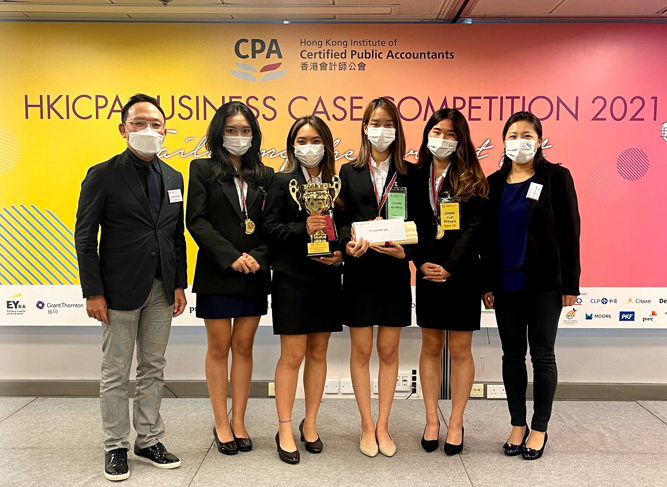
Group photo

From left to right: Mr. Raymond Cheng, President of the Hong Kong Institute of Certified Public Accountants; Zang Ke Ke, Coco; Chan Hoi Ching, Ella; Leung Ka Wing, Kary; Chan Yuet, Mikayla; Dr. Winnie S.C. Leung, Assistant Dean (Undergraduate)

The HKU Business School team won the 1st runner-up in HKICPA Business Case Competition 2021. This year, the competition received a total of 657 team entries from various institutions in Hong Kong, Greater China and Macau regions.

The HKICPA Business Case Competition is an inter-tertiary event that aims at developing students’ business skills, cultivating their professional judgment and preparing themselves for the business environment. Participating teams were required to submit written proposals on a case study in the fashion industry for screening. After several rounds of evaluation, six finalist teams were selected for competing in the Final Oral Presentation Day on November 20, 2021.

Team members:

Chan Hoi Ching, Ella (team leader) – BBA

Chan Yuet, Mikayla – BBA (Acc&Fin)

Leung Ka Wing, Kary – BBA

Zang Ke Ke, Coco – BEcon&Fin

Faculty advisor: Dr. Jasmine KWONG

Student’s Sharing:

We were new to case competition, and we were new to each other.

Things began when I saw the case competition poster distributed at the end of the orientation camp and asked, ‘Is anyone interested in joining it with me?’ Frankly, I was just randomly asking and did not expect that I could form a team. I asked this question so many times, but it never happened to go the way I wished – forming a team is difficult! This time, I ‘successfully’ formed a team of four. Having the opportunity to join the competition made me feel excited, while at the same time, worried. I had only known my teammates for 2 days, and there were a lot of uncertainties. I had no idea if they were truly willing to take up the responsibility, were we capable or simply whether we could coordinate well. Fortunately, even though our schedules were packed with deadlines, tests, and more in these three months, none of us treated the competition as posteriority. We not only got our parts done but also initiatively helped each other.

We never imagine we can go so far since we were selected among 657 teams to be one of the six finalist teams in the undergraduate category and, finally, getting the 1st Runner-up. We are not the only people who contribute to our success. We appreciate this opportunity offered by HKICPA as we have learned a lot throughout the competition and from the adjudicators’ comments. My professor also advised on our presentation deck, and HKU Business School reached out to us to see if we needed a coach. We are lucky to have all these support and resources.

Participating in a case competition is a great opportunity to learn, from technical skills like proposal writing and presentation skills to soft skills, namely communication skills, teamwork, agility and stress management skills. We are looking forward to joining other case competitions together in the near future, and we recommend you to take the initiative to grow and improve.

Last but not least, I would like to thank my teammates. From the worries to now, we have experienced a lot, and I am grateful and proud to say, ‘We are the dream team!’

by Chan Hoi Ching, Ella (team leader)


Learn more about the competition

https://www.hkicpa.org.hk/en/Become-a-Hong-Kong-CPA/QP-Student-support-and-benefits/QP-Affiliate-Club/HKICPA-Business-Case-Competition

https://ug.hkubs.hku.hk/competition/hkicpa-business-case-competition-2021

Read More

From Being the First Mei Tuan Intern to Becoming “Forbes 30 under 30 Asia” Entrepreneur: Waterdrop Founder Shared His Journey in Business Innovation

Leaving a promising career and starting a new venture is something that many have envisioned but yet taken the initiative as it requires courage, determination and vision to forge a new path amid this ever-changing and globalized world. The seminar “與CEO對話: 水滴公司沈鵬談創新創業” was successfully held on 23 September, 2021, which drew more than 100 participants to learn about business innovation and entrepreneurial spirits. Waterdrop founder and “Forbes 30 under 30 Asia” entrepreneur Mr. Shen Peng shared inspiring stories on how his work experiences had emboldened him to set up his own venture and how he decided to tap into the unexplored segment of the Chinese insurance market. Waterdrop is currently one of the largest and fastest growing online insurance firms in China, which has revolutionized the insurance industry and created better medical protection for the young and the underprivileged.

Brewing entrepreneurial spirit at Mei Tuan

Despite starting as a customer service intern, Mr Sheng said that the stimulating and fast paced working environment at Mei Tuan has enabled him to learn, grow, develop skills to cope with unforeseeable challenges and soar high. Therefore, he advised fresh graduates should not to choose their first job solely based on salaries. Instead, they should opt for the ones that provide plentiful opportunities to thrive. In 2013, he had the first taste of business innovation as he led his team to launch the Mei Tuan Takeaway platform. Utilising artificial intelligence and data-driven technology, the platform has stood out from the crowd and become the largest on-demand food delivery firm, which handles at least 4 million orders daily.

Kickstarting new business with social values

However, his ambition did not stop there. His adventurous gene drove him to step out of his comfort zone and make a fresh start. Subsequently, Mr. Shen shared the reason for setting up Waterdrop when he saw a loophole in the Chinese insurance market, in which people in the rural areas and third tier cities were uninsured because of the high cost and high thresholds.  With the aspiration of providing affordable insurance, he further explained how he had leveraged on the advancement of technology and created the crowdfunding platform Waterdrop to empower the people who are left out of the loop of the traditional insurance system.

Building a good team is prerequisite to business success

He further spilled the secrets of how he had steered the company to be the first Chinese insurance firm listed on the New York Stock Exchange. He holds the belief that having a good team is pivotal to the success of any firm as diversity and agility of the team foster communication and innovation. Drawing from the book “The Lean Startup” by Eric Ries and Jack Welch’s approaches in leadership, he further explained his philosophy in marketing and management strategies.

The seminar concluded with his encouraging tips on entrepreneurship and eager exchange of ideas between Mr. Shen and the students.

Read More

Meet our Young King of Stocks – HKU Business School student Mr. CAI Justin Anderson shines at the 6th Joint University Investment Game

Congratulations! BBA (Acc&Fin) student Mr. CAI Justin Anderson is crowned the Overall Champion in the category of “Stocks” at the 6th Joint University Investment Game!

Being the largest investment competition for University students in Hong Kong, it has attracted more than 3000 participants from over 14 universities and 20 student unions across Hong Kong and Shenzhen. During the competition, there are 6 market segments where contestants can trade: Stocks, CBBC, Warrants, ETP, Index Futures and Index Options. The top 10 contestants with the highest portfolio values enter the final.

Student’s Sharing:

I would like to thank HKU, that it has provided me with a platform to network with different successful mentors and peers and boosted my investment knowledge. As a student majoring in Accounting and Finance, courses offered within the programme have contributed to my success in this competition as well.  For instance, different advanced Accounting and Finance-related courses such as financial statement analysis, Equity Valuation, and Investment Management have equipped me with the skillset of reading and analysing an individual company’s performance, which is essential when making investment decisions. I can put the theories that I’ve learned into practice during this competition through a real investment environment.

Looking forward, I wish to pursue my dream job as an analyst and equity fund manager by utilising the vigorous academic training I have been given. I wish to serve the industry by providing professional insights for my future clients and I believe this will be developed as my lifetime interest.

CAI Justin Anderson, BBA(Acc&Fin)

Learn more about the competitionhttp://www.juig.hk/JUIG.html

Read More

Combining Computational Intelligence into Marketing – Dr. Xi LI

Born with a strong sense of curiosity, Dr. Xi Li is deeply interested in marketing strategies and economic phenomena. Impressed by the high quality of research and the rapid growth of HKU Business School, Dr. Li had officially joined us in July 2021 as an Associate Professor in Marketing.

Curious about product pricing in supermarket

“When I shop in the supermarket, I always pay attention to product price. I ask myself why a product is sold at $100 yesterday, but at $80 today. Why isn’t it sold at $80 every day? Is this really good for the company?” Dr. Li said with a laugh that he was already exhibiting the curiosity of a researcher prior to becoming a marketing scholar.

Although being interested in marketing and economics, Dr. Li had chosen to study computer science in his undergraduate years. He explained that, “The IT sector was taking off back then, and I had a strong feeling that it will be world-changing. In addition, the more I know about computer science, the more I realise how it can be used to solve managerial issues and even helping managers to make marketing decisions.” After being trained as a computer scientist, Dr. Li had also taken a Master’s degree in Operations Research and a PhD in Management, and combines knowledge from these areas to address real-life marketing problems. Although existing economics and marketing theories can explain a lot of business phenomena, the emergence of new issues requires marketing scholars to create new knowledge, and provide new answers. The opportunities and problems that big data brings to marketers are one of them.

Researching quantitative marketing with a two pronged approach

As the development of big data is gaining steam, Dr. Li is interested in studying how this new player can facilitate marketers in pricing and other marketing decisions. In addition to conducting empirical research, Dr. Li also strives to leverage his expertise in computer science to better analyze marketing data. “Other than traditional numerical data, text, graphics and videos are also data that could potentially be processed into big data. I am seeking to develop algorithms to help marketers use these data to understand their consumers.” said Dr Li.

Studying big data from policy making perspective

A recent paper written by Dr. Li studies the privacy issues brought by big data. “Nowadays firms may know you more than you know yourself. For example, search engines know about your interests, ride-hailing apps record your daily routine, sales platforms understand what products and brands are your favourites. As the information asymmetry between firms and consumers have reversed, consumers often feel uneasy about it,” said Dr. Li.

Against this backdrop, Dr. Li had conducted a research from a policy making perspective on how government regulate private companies on their data collection behaviours. Dr. Li posits that firms will explore every possible avenue to collect data from consumers without government regulation. The paper will look at existing data regulation regimes in the EU and the US, and also the Chinese government’s follow-up actions against the data hoarding behaviours of Didichuxing. Dr. Li believes that firms should strike a balance between profit maximisation and social responsibilities. “Data collection is neutral, but the government should take the market condition into consideration while deciding whether restrict a firm’s data collection practice,” said Dr. Li.

To nurture marketing students with advanced computational knowledge

Apart from contributing his expertise in computer science to propel the development of marketing research, Dr. Li also seeks to upskill the competitiveness of HKU marketing majors’ students by equipping them with advance IT skills. He foresees that quantitative marketing is the future, students must learn how to conduct big data analysis in order to stay relevant in the market. In sem 1 2021, Dr. Li will be teaching digital marketing for undergraduate, delivering knowledge of algorithms and big data for postgraduate.

Dr. Li believes that HKU Business School is an ideal place for academic research. He commented that, “The reputation of HKU and the faculty’s strong connection with the Asian-Pacific business community can definitely help marketing scholars to conduct research more effectively, which in turn enables scholars to deliver update knowledge to students, and nurture high quality talents for the society.”

Read More