




Data to Dynasties: Fresh Insights into China’s Past from New Edited Volume
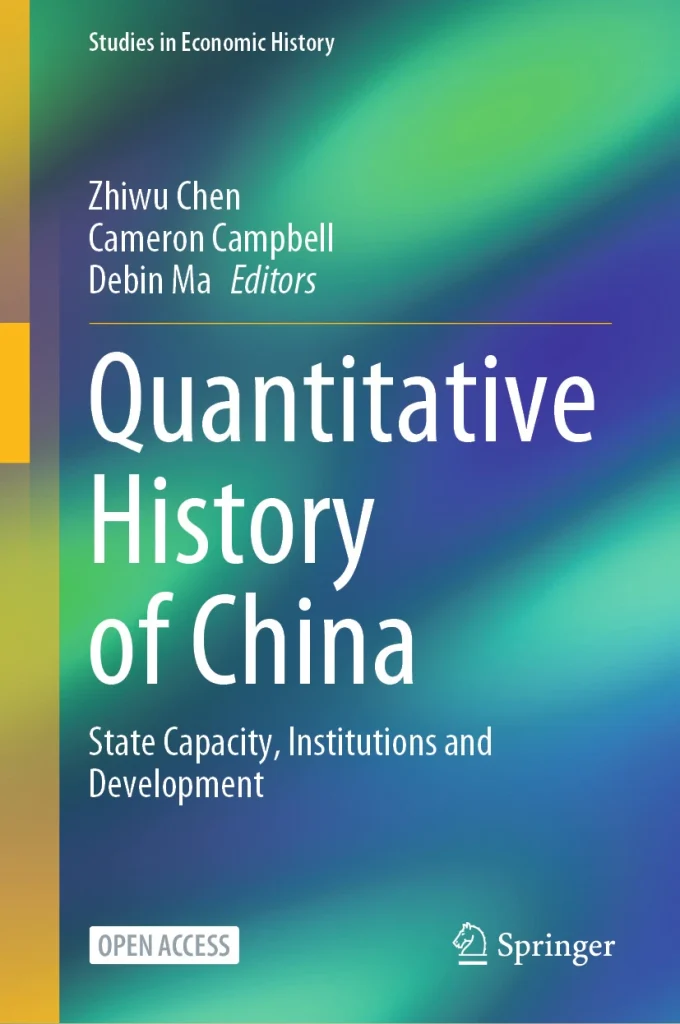
The Centre for Quantitative History (CQH) is proud to announce the forthcoming publication of Quantitative History of China: State Capacity, Institutions, and Development, an edited volume that represents a milestone in the study of China’s long-run political, social, and economic development.
Published by Springer Nature in its prestigious Studies in Economic History series, this Open Access book brings together 11 insightful studies first presented at the CQH’s Area of Excellence-Quantitative History 2023 conference.
The volume will be officially published in October 2025 and is now freely accessible to scholars, students, and the public worldwide.
A new era for studying Chinese history
In recent decades, quantitative methods have increasingly shaped historical research, yet studies of China’s past have often been constrained by limited archival access and the difficulty of processing large amounts of historical data. The rise of advanced computing power and machine-assisted reading now makes it possible to construct and analyse vast historical datasets, opening new opportunities for understanding China’s development over the past three millennia.
This volume showcases pioneering research that leverages these new capabilities, offering fresh insights into critical questions about China’s long-run development. Interdisciplinary teams of economists, sociologists, political scientists, historians, and econometricians explore topics ranging from the role of war and state formation, religion and culture, finance and institutions, technological innovation, regicide, and the organization and capacity of the imperial bureaucracy.
Key themes and contributions
The chapters in Quantitative History of China cover a wide range of topics, including:
- War, Technology, and the Needham Puzzle
- War and Demand for Technology: How Unification Disincentivized Innovations in Historical China
- War and Demand for Technology: Archaeological Evidence from Early China
Two chapters by Zhiwu Chen, Senhao Hu and Zhan Lin combine historical analysis with archaeological evidence to explain how political unification in China reduced incentives for technological innovation, engaging directly with the famous Needham Puzzle.
- Rulers, Institutions, and the Military
- A Quantitative History of Regicide in China (Zhiwu Chen and Zhan Lin) — Systematic measurement of political instability through the lens of regicide across dynasties.
- War Breeds Warriors (Yicheng Chen, Zhiwu Chen and Chicheng Ma) — How historical conflicts shaped enduring warrior cultures.
- Origin and Deployment of Qing Military Officers (Jun Chen and Cameron Campbell) — New data on provincial origins and careers of Qing officers.
- The Impact of Crises on County Magistrates (Cameron Campbell and Shuaiqi Gao) — The effects of famines, rebellions, and other crises on local governance in late imperial China.
- State Capacity, Fiscal and Financial Development
- How to Finance Wars (William Guanglin Liu and Kai Wan Kwan) — The Northern Song’s fiscal innovations and the securities crisis of the 1040s.
- Fiscal Revenue in Ming and Qing China (Hanhui Guan, Debin Ma and Runzhuo Zhai) — Quantitative reconstruction of state revenues over five centuries.
- Why Did Qing China Fail to Establish Fiscal Federalism? (Yu Hao and Kevin Zhengcheng Liu) — Analysis of central-local fiscal relations and the limits of state capacity.
- The Rise and Fall of Shanxi Banks (Wentian Diao, Jinyan Hu and Chicheng Ma) — Political economy insights into China’s historic banking networks.
- Religion and Agricultural Development
- Protestantism and Agricultural Development in China (Ying Bai and Xiaoyu Bian) — Evidence on how religious movements shaped rural economic growth.
Leading scholars advancing Quantitative History research
Contributors include leading experts in quantitative historical research on China, drawing on newly developed large-scale datasets. It is worth noting that some of the articles were co-authored by our team together with research students, reflecting our commitment to collaborative scholarship and training the next generation of researchers. Taken together, these studies highlight the transformative potential of big data and quantitative analysis in answering fundamental questions about the interplay between institutions, state capacity, and socioeconomic change across centuries.
Why this book matters
Quantitative History of China will be an essential resource for anyone interested in Chinese economic, political, social, or institutional history, as well as for scholars and students of quantitative history more broadly. By making this work available Open Access, the CQH and Springer Nature aim to foster wider engagement, cross-disciplinary dialogue, and deeper understanding of China’s historical trajectory and its relevance to contemporary challenges.
Publication Details
Title: Quantitative History of China: State Capacity, Institutions, and Development
Editors: Zhiwu Chen, Cameron Campbell, Debin Ma
Publisher: Springer Nature
Series: Studies in Economic History
Format: Open Access (OA)
Release Date: October 1, 2025
This edited volume is published as an Open Access book under the CC BY-NC-ND 4.0 license. The content can be freely downloaded and used for non-commercial purposes. Please remember to cite the source and include the DOI when referencing the work.
The edited volume is now available at: Quantitative History of China: State Capacity, Institutions and Development | SpringerLink