


Innovation Networks in the Industrial Revolution
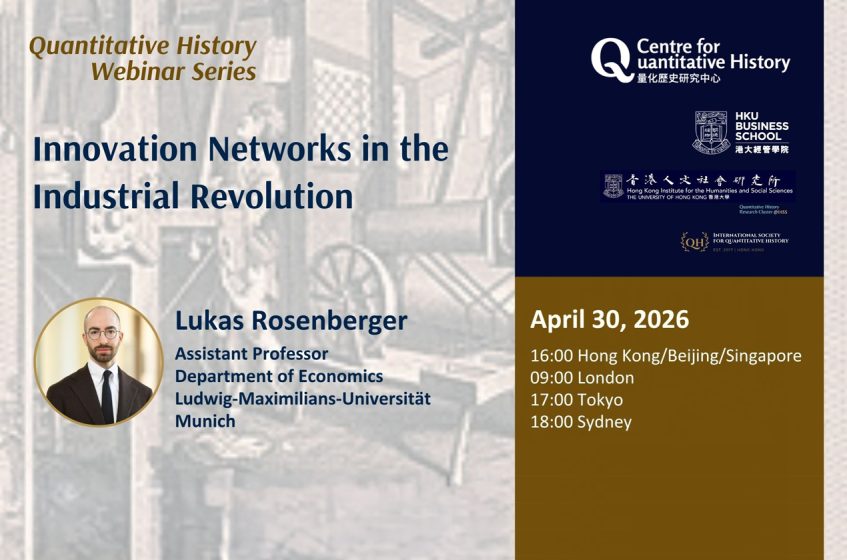
Innovation Networks in the Industrial Revolution
In this Quantitative History Webinar, Lukas Rosenberger of Ludwig-Maximilians-Universität Munich will introduce a new approach to understanding technological progress and economic growth during the Industrial Revolution by combining modern growth theory with detailed micro-data. Lukas and his co-authors develop a multi-sector endogenous growth model to study one leading theory of British advantage during the Industrial Revolution: knowledge access costs. They apply their model to patent data from Britain and France in order to estimate key parameters, including vectors of country and technology-specific knowledge access parameters. They validate their estimates and then use the model to study their implications during the transition to modern economic growth. They show that, relative to France, British inventors faced lower knowledge access barriers, a difference that generated meaningful growth rate differences on the transition path, even when accounting for cross-country knowledge and technology flows.
Lukas Rosenberger’s co-authors: W. Walker Hanlon (Northwestern University), Carl Hallmann (Jane Street)
Date: April 30, 2026
Time: 16:00 – 17:30
16:00 (Hong Kong/Beijing/Singapore)
04:00 (New York)|01:00 (Los Angeles)|09:00 (London)|17:00 (Tokyo)|18:00 (Sydney)
Venue: Zoom Webinar
Language: English
The Quantitative History (QH) Webinar Series aims to provide researchers, teachers, and students with an online intellectual platform to keep up to date with the latest research in the field, promoting the dissemination of research findings and interdisciplinary use of quantitative methods in historical research. The QH Webinar Series, now entering its sixth year, is co-organized by the Centre for Quantitative History at the HKU Business School and the International Society for Quantitative History in partnership with the Hong Kong Institute for the Humanities and Social Sciences. The Series is now substantially supported by the Areas of Excellence (AoE) Scheme from the Research Grants Council of the Hong Kong Special Administrative Region, China (Project No. [AoE/B-704/22-R]).
Conveners: Professors Zhiwu Chen & Chicheng Ma