


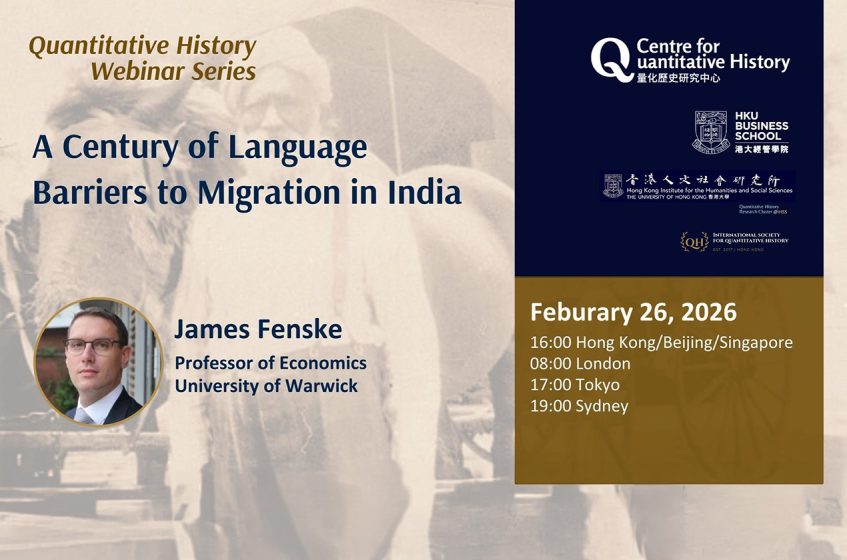
A Century of Language Barriers to Migration in India
A Century of Language Barriers to Migration in India
Combining detailed data on language and migration across colonial Indian districts in 1901 with a gravity model, Professor James Fenske of the University of Warwick and his co-authors find that origin and destination districts separated by more dissimilar languages saw less migration. They control for the physical distance between origin-destination pairs, several measures of dissimilarity in geographic characteristics, as well as origin and destination fixed effects. The results are robust to a regression discontinuity design that exploits spatial boundaries across language groups. They also find linguistic differences predict lower migration in 2001. In this Quantitative History Webinar, James will explore in detail how cultural channels account for only a small part of the link from linguistic diversity to lower migration. Rather, the evidence suggests communication and information channels are more important.
James Fenske’ co-authors: Latika Chaudhary (Naval Postgraduate School in California, U.S.A) and Yannick Dupraz (Paris Dauphine University)
Discussant: Mark Hup, Research Assistant Professor, Department of Economics, The Chinese University of Hong Kong
Date: February 26, 2026
Time: 16:00 – 17:30
16:00 (Hong Kong/Beijing/Singapore)
03:00 (New York)|00:00 (Los Angeles)|08:00 (London)|17:00 (Tokyo)|19:00 (Sydney)
Language: English
The Quantitative History (QH) Webinar Series aims to provide researchers, teachers, and students with an online intellectual platform to keep up to date with the latest research in the field, promoting the dissemination of research findings and interdisciplinary use of quantitative methods in historical research. The QH Webinar Series, now entering its sixth year, is co-organized by the Centre for Quantitative History at the HKU Business School and the International Society for Quantitative History in partnership with the Hong Kong Institute for the Humanities and Social Sciences. The Series is now substantially supported by the Areas of Excellence (AoE) Scheme from the Research Grants Council of the Hong Kong Special Administrative Region, China (Project No. [AoE/B-704/22-R]).
Conveners: Professors Zhiwu Chen & Chicheng Ma