


The Structure and Nature of Land Tax Data in Ming China: The Case of Surcharges
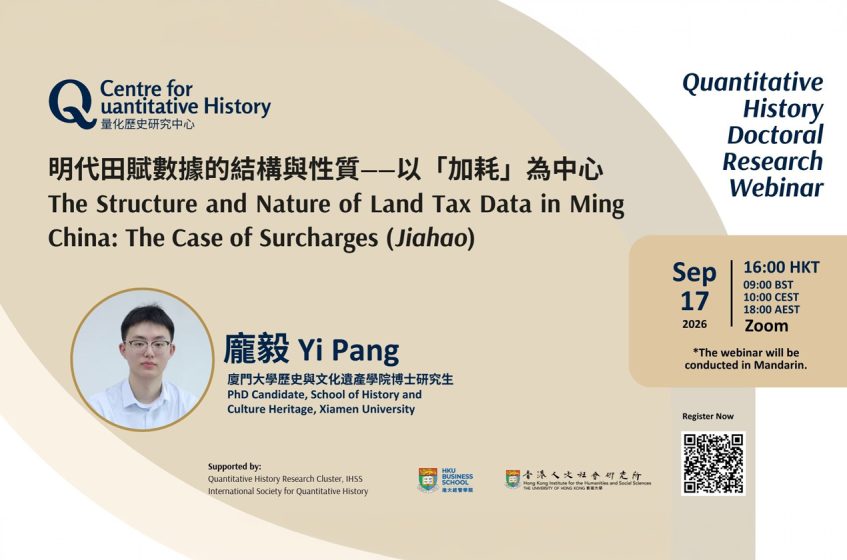
The Structure and Nature of Land Tax Data in Ming China: The Case of Surcharges 明代田賦數據的結構與性質——以「加耗」為中心
The Structure and Nature of Land Tax Data in Ming China: The Case of Surcharges (Jiahao)
Ming land tax data are characterised by widespread structural omissions, most clearly illustrated by the exclusion of surcharges (jiahao). These omissions limit the extent to which the data capture the tax system in its entirety. The incompleteness of these records reflects a fundamental difference between central and local perspectives on fiscal accounting. The central government focused exclusively on annual revenue, defined as net treasury receipts, whereas local governments had to meet the full tax burden, including surcharges. Calculating surcharge rates therefore clarifies the structure and nature of Ming land tax data and enables the reconstruction of actual tax amounts at the local level.
Discussant: Yongqin Guo, Professor, School of Humanities, Guangzhou University
*This webinar will be conducted in Mandarin.
明代田賦數據的結構與性質——以「加耗」為中心
明代田賦數據普遍存在結構性缺失,這在「加耗」這一問題上得以集中體現。 加耗的遺漏,導致明代田賦數據難以反映真實稅制全貌。 這些不完整數據的背後,其實是中央與地方財政會計視角的根本差異,中央政府只關注入庫淨額的「歲入」,而地方政府需負擔包括加耗在內的全部「稅負」。 廈門大學歷史與文化遺產學院博士研究生龐毅通過計算加耗率,更清晰地闡述明代田賦數據的結構與性質,以及恢復地方政府的實際稅額。
評論人: 廣州大學人文學院歷史系教授郭永欽
Date: September 17, 2026
Time: 16:00 – 17:30
16:00 (Hong Kong/Beijing/Singapore)
04:00 (New York)|01:00 (Los Angeles)|09:00 (London)|17:00 (Tokyo)|18:00 (Sydney)
Venue: Zoom Webinar
Language: Mandarin
The Quantitative History (QH) Webinar Series aims to provide researchers, teachers, and students with an online intellectual platform to keep up to date with the latest research in the field, promoting the dissemination of research findings and interdisciplinary use of quantitative methods in historical research. The QH Webinar Series is co-organised by the Centre for Quantitative History at the HKU Business School and the International Society for Quantitative History in partnership with the Hong Kong Institute for the Humanities and Social Sciences. The Series is now substantially supported by the Areas of Excellence (AoE) Scheme from the Research Grants Council of the Hong Kong Special Administrative Region, China (Project No. [AoE/B-704/22-R]).
Conveners: Professors Zhiwu Chen & Chicheng Ma