



Movement and the State
Movement and the State
In this Quantitative History Webinar, Qiong Zhang of Renmin University of China will examine how the May Thirtieth Movement of 1925—a short-lived, nationwide anti-imperialist mobilization led primarily by the newly founded Chinese Communist Party (CCP) and swiftly repressed—shaped state formation in China over subsequent decades.
Using spatial variation in exposure to the movement, Zhang finds that it accelerated local CCP organization and generated spillovers through member migration and the spread of organizational models. The party’s growth coincided with ideological change, including more communist-related books and stronger working-class associations in newborn names, but little evidence of greater military capacity or fewer attacks by rival parties. During the full-scale civil war, the CCP captured exposed areas earlier than comparable areas. After the founding of the People’s Republic of China, those areas showed more radical behaviour during far-left campaigns, slower adjustment to rightward policy shifts, and, by the twenty-first century, greater government dissatisfaction and stronger anti-foreign attitudes.
Discussant: Jianan Li, Professor, School of Economics and the Wang Yanan Institute for Studies in Economics (WISE), Xiamen University
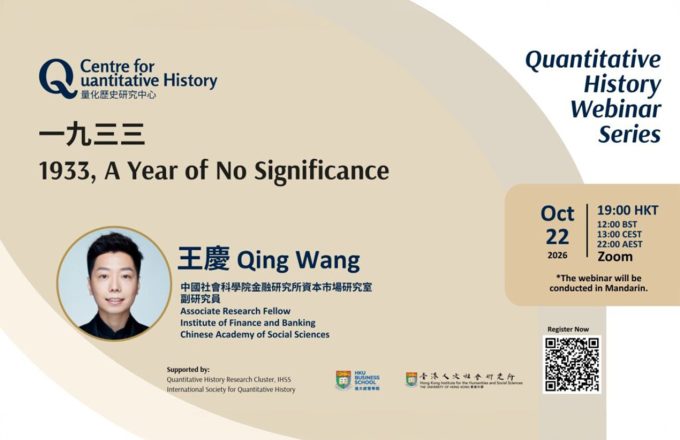
*This webinar will be conducted in Mandarin.
Time: 16:00 – 17:30
16:00 (Hong Kong/Beijing/Singapore)
03:00 (New York)|00:00 (Los Angeles)|08:00 (London)|17:00 (Tokyo)|19:00 (Sydney)
Venue: Zoom Webinar
Language: English
The Quantitative History (QH) Webinar Series aims to provide researchers, teachers, and students with an online intellectual platform to keep up to date with the latest research in the field, promoting the dissemination of research findings and interdisciplinary use of quantitative methods in historical research. The QH Webinar Series is co-organised by the Centre for Quantitative History at the HKU Business School and the International Society for Quantitative History in partnership with the Hong Kong Institute for the Humanities and Social Sciences. The Series is now substantially supported by the Areas of Excellence (AoE) Scheme from the Research Grants Council of the Hong Kong Special Administrative Region, China (Project No. [AoE/B-704/22-R]).
Conveners: Professors Zhiwu Chen & Chicheng Ma