


Gold and Trade: An Empirical Simulation Approach
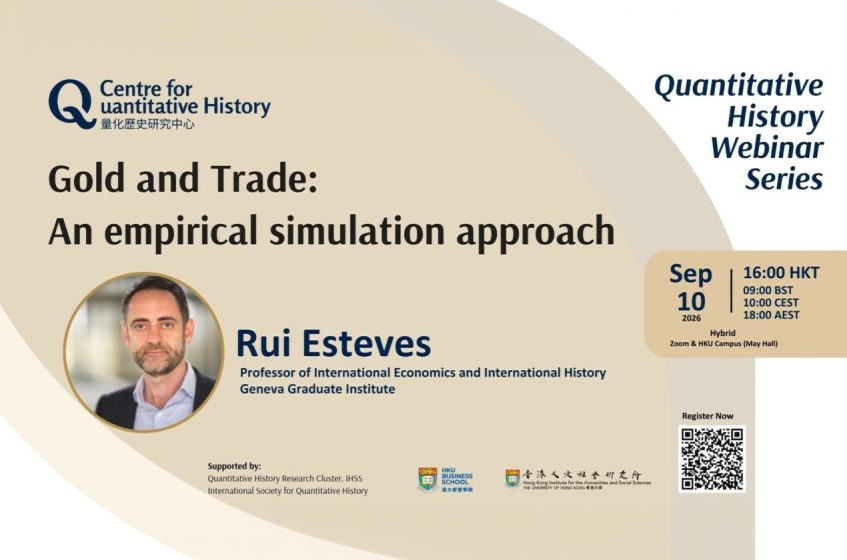
Gold and Trade: An Empirical Simulation Approach
Rui Esteves of Geneva Graduate Institute and his co-authors examine the rise of the classical gold standard from the 1860s to World War I through the reciprocal relationship between trade and monetary regimes. Existing gravity estimates cannot identify this relation cleanly because trade and regime choice are jointly endogenous and bilateral trade depends on wider network structure, even after standard corrections.
In this Quantitative History Webinar, Rui Esteves will show that the trade networks strongly shaped monetary choices: countries tended to adopt the regimes of their main trading partners, using a dynamic social network model. By contrast, the evidence provides little support for the classic gravity-model claim that shared regimes substantially increased trade.
Rui Esteves’ co-authors: Youssef Ghallada (London School of Economics and Political Science) and Florian Ploeckl (The University of Adelaide)
Date: September 10, 2026
Time: 16:00 – 17:30
16:00 (Hong Kong/Beijing/Singapore)
04:00 (New York)|01:00 (Los Angeles)|09:00 (London)|17:00 (Tokyo)|18:00 (Sydney)
Venue: May Hall, HKU Campus
Language: English
The Quantitative History (QH) Webinar Series aims to provide researchers, teachers, and students with an online intellectual platform to keep up to date with the latest research in the field, promoting the dissemination of research findings and interdisciplinary use of quantitative methods in historical research. The QH Webinar Series is co-organised by the Centre for Quantitative History at the HKU Business School and the International Society for Quantitative History in partnership with the Hong Kong Institute for the Humanities and Social Sciences. The Series is now substantially supported by the Areas of Excellence (AoE) Scheme from the Research Grants Council of the Hong Kong Special Administrative Region, China (Project No. [AoE/B-704/22-R]).
Conveners: Professors Zhiwu Chen & Chicheng Ma