IBDS x IPUR Conference 2026 Explores Health, Risk, and Decision Making in a Fast-Changing World
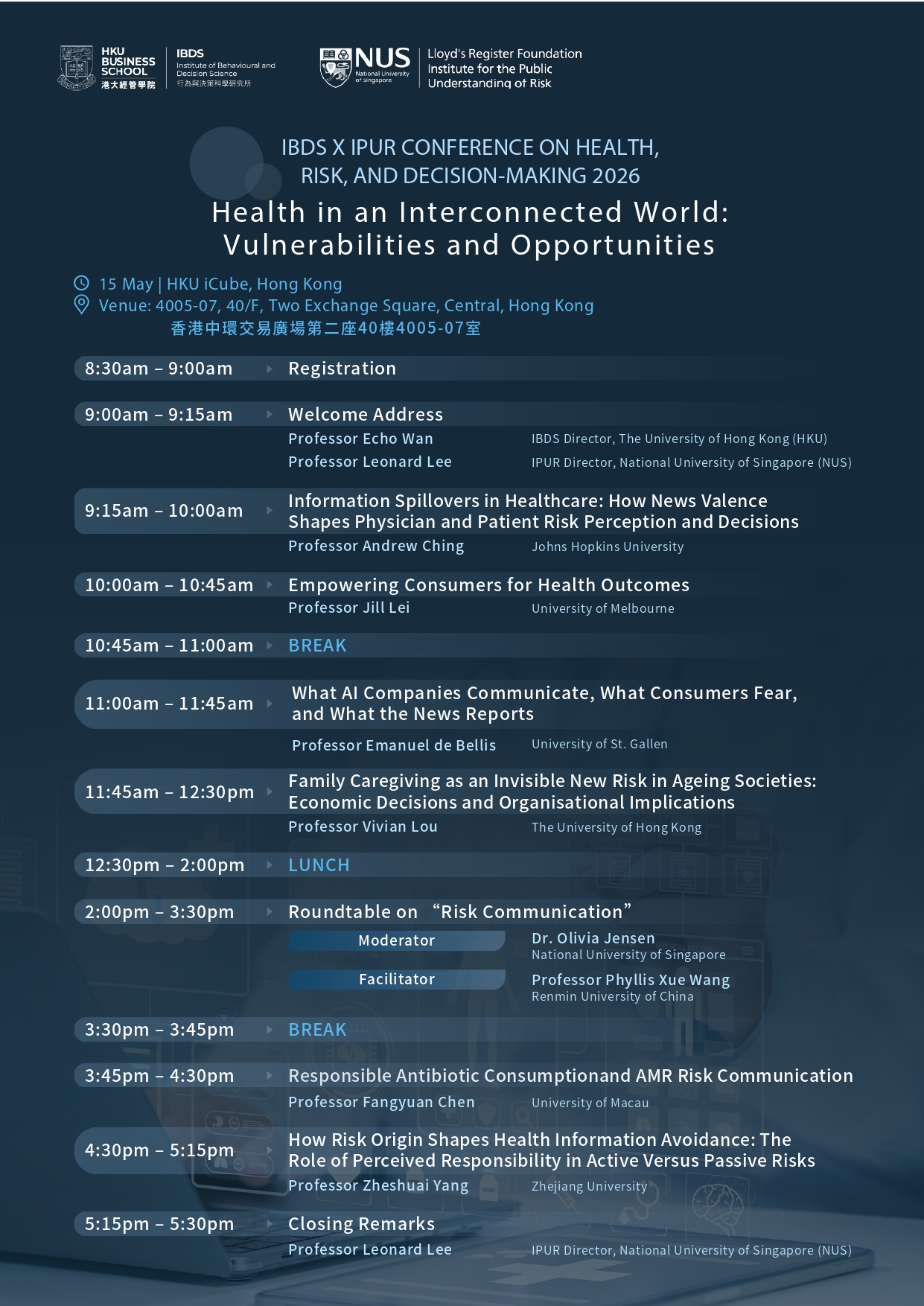
15–16 May 2026, Hong Kong & Shenzhen – The Institute of Behavioural and Decision Science (IBDS) at HKU Business School, together with the Lloyd’s Register Foundation Institute for the Public Understanding of Risk (IPUR) at the National University of Singapore, successfully held the two‑day “Conference on Health, Risk, and Decision‑Making 2026 – Health in an Interconnected World: Vulnerabilities and Opportunities.” The event brought together leading academics, medical professionals, and industry experts to discuss how information, technology, and societal changes shape risk perception and health choices.
Opening Remarks
The conference opened with welcome addresses by Professor Echo Wan (IBDS Director, HKU) and Professor Leonard Lee (IPUR Director, NUS). They set the stage by emphasising the conference’s core mission: to bridge behavioural science, public health, and policy in an era of rapid technological change and emerging health risks.
Hong Kong Session – HKU iCube
- Andrew Ching(Johns Hopkins University) presented three studies on information spillovers. He showed that “borderline high” cholesterol test results increase patients’ preference for brand‑name drugs, and that a positive brand‑equity shock (Pfizer’s COVID‑19 vaccine announcement) reduced adverse event reporting. He also demonstrated how news coverage and pharmaceutical detailing can be either substitutes or complements, depending on the complexity of the medical information.
- Jill Lei(University of Melbourne) introduced a consumer‑empowerment framework. Her research revealed two distinct psychological pathways: low‑SES patients prefer aggressive treatments because of uncertainty avoidance, whereas high‑SES patients do so because they value their future life more. She called for decision aids that reduce uncertainty for disadvantaged groups.
- Emanuel de Bellis(University of St. Gallen) compared what AI companies communicate, what consumers fear, and what the news actually reports. He highlighted systematic mismatches that can lead to public mistrust.
- Vivian Lou(University of Hong Kong) framed family caregiving as a “new risk” in ageing societies – invisible, incalculable, and systemic. Using data from Hong Kong, the US, the UK, Australia, and Singapore, she showed that unpaid caregiving creates enormous economic value yet remains largely unacknowledged in actuarial models and workplace policies. She proposed employer‑based support, pension credits for caregivers, and integrated policy responses.
- Fangyuan Chen(University of Macau) addressed antimicrobial resistance (AMR). She argued that antibiotic misuse is driven by a universal psychological need for control – not a lack of awareness. Her control‑alignment framework recommends redesigning healthcare touchpoints so that the control‑restoring choice is also the clinically safe choice. She further introduced a dual‑level risk appraisal framework with five audience segments (e.g., “Detached Dismissers”, “Overwhelmed Avoiders”), each requiring a tailored messaging strategy.
- Zheshuai Yang(Zhejiang University) explored how the origin of a health risk (active vs. passive) affects information avoidance. His findings show that people are more likely to avoid information when they feel personally responsible for the risk.
- A Roundtable on “Risk Communication”, moderated by Olivia Jensen(NUS) and facilitated by Phyllis Xue Wang (Renmin University of China), sparked lively debate. Olivia Jensen designed several real‑world scenarios (e.g., discussing multi‑cancer early detection tests with a parent) to guide the discussion. Speakers and audience members actively engaged on how to present absolute vs. relative risks, communicate uncertainty, and tailor messages to different audiences.
Shenzhen Session – HKU Business School Shenzhen Center
Before the academic sessions, Professor Echo Wan gave special opening remarks highlighting the strategic importance of the HKU Business School Shenzhen Center. She introduced the Centre’s role in delivering MBA programmes and Executive Education, emphasising HKU’s commitment to cross‑border education and research collaboration with mainland China.
The second day focused on technology, chronic disease prevention, and cross‑border health challenges.
- E Shyong Tai(NUS) gave a keynote on supporting behaviour change for chronic disease prevention. He argued that traditional risk communication often fails because it does not address people’s emotions, beliefs, and automated choices. He presented a risk‑communication tool using “metabolic age” to increase perceived vulnerability, and introduced the HOPE mobile platform that aligns health advice with what individuals already value (e.g., social connection, stress relief).
- Haiyang Yang(Johns Hopkins University) discussed autonomous medical AI across different levels of autonomy. He presented experiments showing that physicians are rated lower by peers when they rely on AI, and that patients still seek human reconfirmation even after receiving a normal AI result. Interestingly, patients are more willing to use an AI that replaces an ophthalmologist when the AI is introduced by an ophthalmologist rather than another specialist.
- Diego Aparicio(IESE Business School) analysed algorithmic pricing in online retail. Using clickstream data from a large US retailer, he demonstrated that repeated exposure to high price variability increases consumers’ price sensitivity – a behavioural “menu cost” that firms should incorporate into their pricing algorithms.
- Fangmin Xie(CEO, OpenVeritas) gave an industry talk on “AI for Doctors.” He presented OpenEvidence, a US‑based medical AI platform that gives doctors free, citation‑linked access to peer‑reviewed literature, monetised through targeted advertising from pharmaceutical companies. He then asked whether China needs a similar platform and discussed the regulatory and commercial challenges.
A final Roundtable on “Healthy Longevity, Technology, and Well‑being”, chaired by Leonard Lee, featured E Shyong Tai, Vivian Lou, Emanuel de Bellis, and Yunlu Yin (Fudan University). The discussion explored what healthy longevity means, whether technology brings us closer to or further from that ideal, how people actually engage with health technologies and the barriers they face, and how to prevent the longevity dividend from becoming a new source of inequality. The panel debated how technology can support ageing populations without eroding human connection, and the role of behavioural science in designing age‑friendly solutions.
From Research to Reality: What We Learned
Across the two days, several cross‑cutting themes emerged. Information is never neutral—it reshapes risk perception in systematic, sometimes unintended ways, as seen in brand preference shifts, under‑reporting of side effects, and avoidance of health information. Psychological needs such as control, certainty, and agency drive health behaviours, meaning that effective interventions must redirect those needs rather than simply provide facts. New risks like antimicrobial resistance and family caregiving are invisible and systemic, requiring multi‑level responses from households, employers, insurers, and governments. Tailored risk communication works: segmenting audiences by their psychological profile—for instance, distinguishing low‑risk dismissers from overwhelmed avoiders—allows more effective messaging. Finally, technology, including AI and algorithmic pricing, changes behaviour; both patients and physicians react to AI autonomy and price variability in ways that firms and regulators must anticipate.
For more information
Institute of Behavioural and Decision Science (IBDS), HKU Business School – ibds@hku.hk